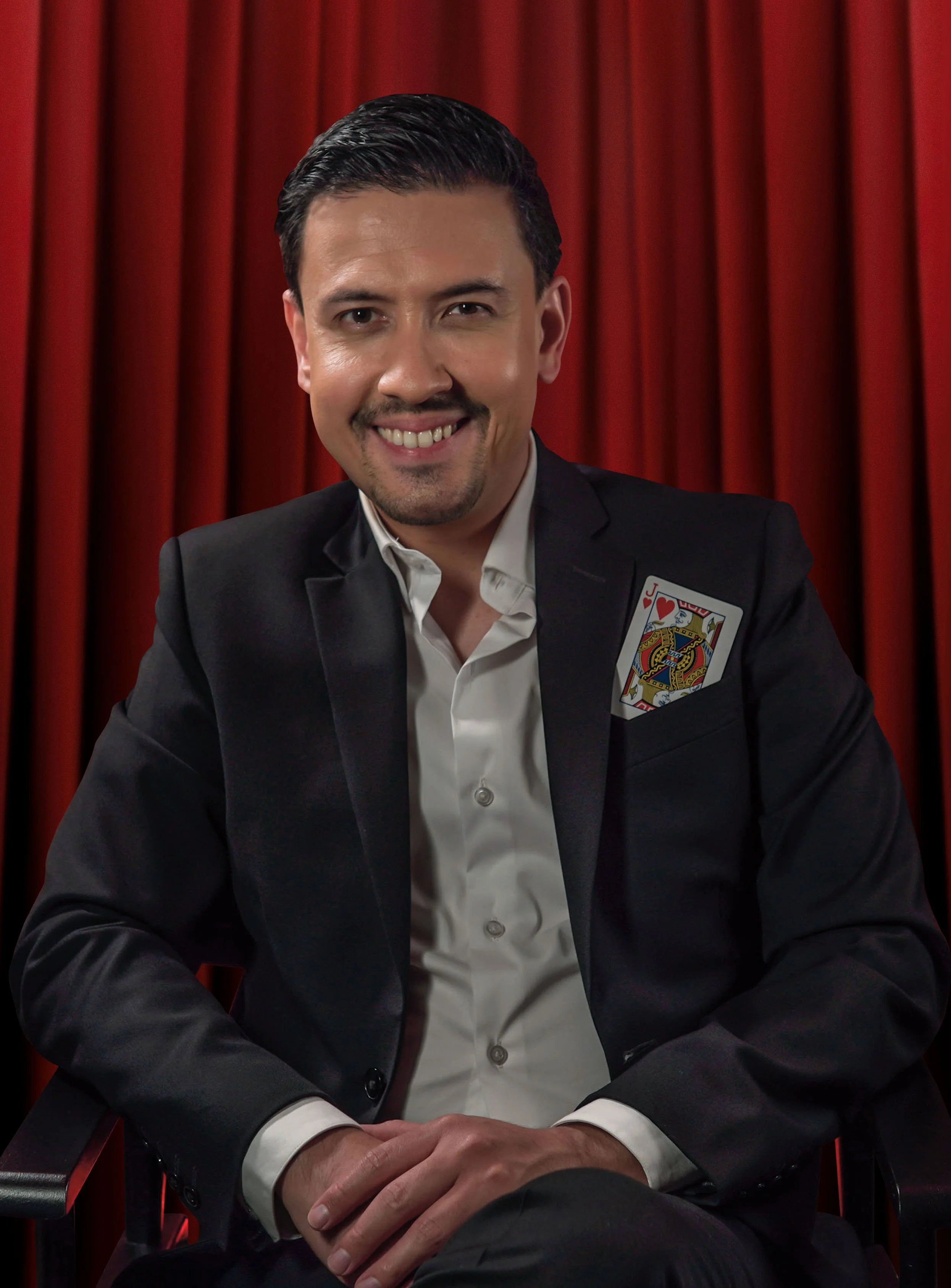
Christopher Moro
Founder, Christopher Moro Entertainment — Burbank, CA
Magician Member, Academy of Magical Arts at the Magic Castle (admitted through formal audition and peer review)
First-place winner, international stage magic competition
Bachelor of Arts., USC School of Cinema-Television
Disciplines: close-up, strolling, parlor, stand-up, stage magic, and mentalism
Serving Los Angeles, Orange County, and Santa Barbara
There weren’t many places to learn the art of magic when I first started, and certainly not from real magicians willing to tell you just how hard it actually was. So after my first fascination with the art, I taught myself. It began with a library book at ten years old, then a few more, poring over pages, trying to decipher how to make what was on the page look amazing, hoping one day, I’d be able to bring audiences the same joy and wonder I’d felt myself.
One genre drew me in more than the others: visual magic using nothing more than my hands, musical accompaniment and the purity of items appearing, vanishing and transforming, with not a single word spoken. Many consider this discipline one of the hardest branches of the craft. I gravitated toward it for a simple reason: watching it done well was the closest I'd ever come to feeling like I was witnessing real magic, and I trusted that if it moved me as an audience member, it would move others, too. I built an act around that instinct, and when I started performing it, audiences gasped and cheered. I guess my instinct was right.
I met a magician working a showroom on the Waikiki strip in Honolulu: Curtis Kam. He was backstage, casually holding a deck of cards while in mid-conversation with friends and crew and cracking jokes the whole time. Something inexplicable was happening in his hands: a card was changing in the blink of an eye. I couldn't place how this was happening. It couldn’t have been a technique I’d read about in one of my books, the one I had concluded was impossible to make look real.
Then it clicked: it was exactly that move. I was witnessing what it was actually supposed to look like. Not a technique but like real magic.
Curtis became the person who taught me the most, by far, over the years that followed — a weekly ritual of performing before his show, watching him work, then staying until early morning while he advised, encouraged, educated, corrected, invented, and pushed me past whatever I thought my ceiling was. One night, messing around on the empty stage, I turned a billiard ball into a fan of cards midair. Suddenly his voice emanated from the darkness: “that was great!” I didn’t even know he was watching. He asked if I did it in my show. I said, no. Then told me something that would completely change how I thought about my own material. That moment became a foundation of the act I spent the next few years building into something that completely shaped my approach to magic.
I was younger than almost everyone else in the competition, most with decades on me, when that act won first place in an international stage magic competition — the youngest to ever take the title. Curtis handed me the trophy.
Winning opened doors fast: corporate bookings, referrals from other magicians, invitations to close out shows I hadn't even auditioned for. I kept refining that act for years afterward — ships, grand ballrooms, theatres, award shows, conventions, fundraisers — building a career that was, by any reasonable measure, already working.
I studied directing and film production at the USC School of Cinema-Television and went on to write, direct, and produce independent films
Directing film meant becoming a surrogate for the audience — feeling what they cared about, what they wanted to see next, what might genuinely surprise them, what would actually move them as human beings, and building every choice around that. I brought that with me to magic, along with something else I hadn't expected: a much clearer sense of what I actually wanted a show to do. Entertainment comes first, always — astonishment, laughter, a genuinely great night, because that's what my client wants. But every so often, when a moment allows for it, I try to let something land a little deeper than the “trick” itself. What the audience needs. The kind of thing a great film does to you without your quite noticing how.
I've watched it happen from my stage or close-up table more than once — someone moved in a way that has less to do with the illusion than with a memory or a feeling the moment happened to touch. More than once, someone's come up to me afterward to say a show brought back a happy memory of someone they love, and made their whole night. I don’t think I’ll ever get used to that… and I hope I never do. People let their guard down in ways that still catch me off-guard: genuine warmth, real relationships built over years with the same clients and hosts, not just a transaction that ends when the show does.
Joining the Magic Castle years later meant two formal interviews about what I could actually contribute, then an audition in front of some of the most accomplished magicians in the art today, followed by a review from the Academy of Magical Arts' board. Some of the most respected names in the room stayed completely stone-faced through the audition itself. Afterward, several came up smiling — and one of them reportedly turned to the board and said simply: hire this guy right now.
Christopher Moro Entertainment, based in the Burbank Media District, is what all of this has become: Magic up close, strolling around cocktail hour, formal miracles in the parlor, silent and not-so-silent magic on stage, stand-up performances, mentalism, all built by someone who taught himself from a library book, was shaped for years by one of the greatest magicians in the field, was encouraged and incredibly supported by family, and used the art of filmmaking to make it better.
That's what a host actually gets: someone who already knows how to read a room before he's even entered it. Where people will naturally gather. When their attention is really available, versus just politely present. And most of all, how to hand a moment back to the people in it, rather than keep it for himself.
It's the same instinct that first pulled me toward this craft as a kid, alone with a library book: the sense that something in a room could genuinely change for the people in it, if you built it carefully enough. That's the feeling I try to bring into every room, corporate stage or private dinner table alike: nothing performed at the guests, but something that happens with them, and afterwards, belongs not to me, but to them.
About Christopher Moro
-
Membership is peer-vetted, not purchased — earned through formal audition and review by working magicians at the Magic Castle in Hollywood, one of the most selective private clubs for the craft anywhere in the world.
-
Directly. Years spent directing taught him to think like an audience surrogate — sensing what a room actually wants to feel, and exactly when to give it to them. That same instinct shapes every show he builds today.
-
The audience is treated as the actual subject of the experience, not spectators to it — close-up, strolling, parlor, stand-up, stage, or mentalism, built around genuine connection rather than a performer holding the spotlight alone.e
Premier Private Entertainment across Southern California, including Los Angeles, Santa Barbara, Orange County, Long Beach, Huntington Beach, Simi Valley, San Diego, and Ventura.